The Lesbian Elders Oral Herstory Project seeks to continue the Lesbian Herstory Archives’ commitment to collecting and sharing Lesbian stories. These oral histories of Lesbian Elders offer experiential insight into the history of Lesbian culture and activism, complementing LHA’s already rich collections. For a unifying theme we have asked our participants to share their experiences with LHA as part of their life history. For the purposes of this project, Elders includes those ages 60 and up. The oral histories that have already been collected will be available either online here or on-site only at the Archives.
We are thankful to the interviewees for sharing their stories and for their interviewers for providing the space for them to do so! These interviews may contain sensitive content, so please take care of yourself while listening. The transcripts below have been edited through a participatory review process. Please take the same care while reading.
Herstories are organized by the first name of the interviewee, modeled on the arrangement of the books at the Lesbian Herstory Archives, “a reflection of the Archives’ founding during the Lesbian-Feminist 1970s.”
Interviewer: Kira Findling
Date: 11/02/2022
waltAmanda Bailey was born in Pensacola, Florida in 1957 to a family with deep roots in Alabama. Being part of a large Southern Baptist family shaped her perception of herself as a “tomboy” and her sexuality until she went to Stephens College in Missouri and fell in love with a woman. Against the political background of the Christian Right, Amanda moved to Phoenix in her early 20s and became involved with advocacy, working with Women’s Weekly magazine, planning Phoenix’s first Gay Pride March, and buying 40 acres of land with Dianne Post to launch the Arizona Women’s Music Festival. In Reno, Amanda became involved with the Women’s Center and helped to start a women’s music radio program. Throughout her life, Amanda continued to contemplate her relationship with gender identities and labels. Eventually becoming nomadic, Amanda traveled the country in a motorhome and has more recently focused on being a grandparent and her writing. She met her partner over 15 years ago in a lesbian RV park.
Transcript
Interviewer: Miranda Perez
Date: 08/21/2021
Anne Charles begins this interview discussing her experience growing up with her mother and grandmother outside of Buffalo, NY, and notes feeling like an “outsider” among many Catholic nuclear families. She attends Barnard College in New York City and grows politicized through exposure to feminism. After college, she comes out and navigates homophobic backlash within her family. She chronicles her relationships, including with her long-term partner, Linda, who she currently lives with and co-produces a news show titled “All Things LGBT.” Across her life, Anne has been involved with Lesbian and feminist publication communities like the historic The Second Wave collective. She taught at University of Wisconsin, Madison; Champlain College in Vermont; and introduced and taught the first Lesbian Literature course in Louisiana at the University of New Orleans. She currently lives in Vermont with Linda after having left Louisiana during Hurricane Katrina in 2005. Anne is energized by this project, the Archives, and ongoing feminist and anti-racist consciousness raising efforts.
Transcript
Interviewer: Elizabeth Fox
Date: 11/20/2021
Audrey Lockwood, in this interview, outlines her childhood in a mid-century, Midwestern, mixed religion family. She talks about the pleasures of growing up on Milwaukee’s east side and then the culture shift of moving to a white, upper middle class suburb for high school. She details the roots of her early feminism, like in shop class where she noted to the boys that she could build a cabinet as well as play violin and quote Shakespeare, unlike them. At the University of Iowa, Audrey met her lifelong partner Kittredge and felt more celebrated for her eccentricity overall. Audrey’s feminism expanded while living in Japan and getting involved with International Feminists of Japan, where she also initially heard about LHA. Her affinity for Japanese culture complicated her move back to the US. She notes, “I [didn’t] know how to be an adult in America.” Together Audrey and Kitt navigated the reverse culture shock of moving home by getting involved with politics in San Francisco and attending their first opera. Back in the states, Audrey continued her career as a successful out lesbian in the corporate world. In that realm, she maintained her stance dating back to childhood: “I’m not here to win you over. It’s about my self respect.”
Transcript
Interviewer: Susan Evans
Date: 01/03/2022
Audrey Seidman enters into a dialogue about the richness of participating in lesbian, Jewish, and women’s communities in Queens and Albany, New York over the course of several decades. Mapping her life by communal, interpersonal, and organizational affiliations—like as an integral early member of SAGE (Services & Advocacy for GLBT Elders)—and membership in All the Queens Women and the Coalition for Lesbian and Gay Rights, Audrey names the ways in which shifting consciousness and community building contributed to long-lasting networks of like-minded company. Audrey articulates the inherent value in recognition and belonging, and offers a passionate engagement of the personal as political as evidenced through her career in NY government.
Transcript
Interviewer: Miriam Harrow
Date: 11/22/2021
In this interview, Barbara DiBernard discusses growing up in an Italian-American family in New Jersey. She reveals her foundational roots born from attending a girls’ summer camp and Wilson, a private women’s college, as a first generation college student in the 1960s. She traces her teaching career from the University of Minnesota to her long-time position at the University of Nebraska, Lincoln. She outlines her journey from a traditional education and career as an English Ph.D and it’s evolution into partnering with the Women’s Studies department where—among other activist activities—she helped build the LGBT studies minor and taught a 21st century Lesbian Literature course until she retired. She names writers that awakened her worldview and “spoke right to [her] heart.” Barbara also speaks to platforms that nourished local, national, and international lesbian communities in her life, including the Michigans Womyn’s Festival and the Lesbian Herstory Archives. Barbara and her wife were the first same sex couple in Lancaster Country, Nebraska to get married.
Transcript
Interviewer: Alexandra Adelina Nita
Date: 11/21/2022
Barbara Kahn was born in Camden, NJ and knew from an early age that she wanted to work in the theater and started going to New York City to pursue that goal. Barbara reflects on the merging of her theater and lesbian communities and both the Theater for the New City and the gay and lesbian group, Village Playwrights, were formative in that. Always including lesbian characters in her plays such as Seating and Other Arrangements, Barbara focuses on those who have been “erased or distorted in popular culture.” In 1990, Barbara co-founded Sisters on Stage in New York which hosted plays and workshops about lesbian theater, and the group also performed during an “Afternoon at the Archives” at LHA when it was still on the Upper West Side. In her personal life, Barbara ruminates on the difference in approaches for coming out that occurred within her own family and in her plays, and the perceptions of female relationships.
Transcript
Interviewer: Jessica Pruett
Date: 08/16/2021
In this life herstory, Beth Levine outlines her childhood growing up in a social justice-oriented Jewish family in United States South in the 1960’s. She recounts her journey through higher education, forging her career path, and her formative experiences in consciousness raising groups. She discusses her involvement in social activism including w.o.m.e.n (Women’s Oppression Must End Now) and the Feminist Federal Credit Union. Beth recounts her long history with LHA since its inception and its impact on her life. Throughout the interview, Beth interweaves reflections about her interpersonal relationships as well as her connections to: place, the women’s movement, and sites of lesbian socialization. As she journeys through these moments of her life, she also invites the listener to share in holding an underlying belief in the possibility for change and the importance of the “ordinary lesbian.”
Transcript
Interviewer: Mallory Leger
Date: 02/23/2022
IIn this life herstory, Carol Crayton discusses building connections rooted in autonomy, empathy, and the fight for liberation. From an early age, she traveled into New York City with her grandmother, who she describes as a big influence on her life. Carol joins the convent for five years but eventually leaves in order to live authentically and come out of the closet. Seeking community, Carol finds her way to groups like NOW, LHA, and Lavender Express. She says, “I appreciate so much that the women who were involved in the groundwork of the Archives, having the dream and then following through on it, and then drawing in so many others to help with this, you know, they’ve created a community onto itself.” Carol highlights the importance of words, a theme that reverberates across her work as a teacher, counselor, and writer. Through her work as a teacher, she builds community with other gay women. Despite having to be closeted at work for their safety, they often took trips together to the city to explore the thriving queer bar scene. Carol reiterates the importance of queer organizing communities, stating “Well, the movements provided— I felt like I was home.”
Transcript
Interviewer: Shay Dax
Date: 12/15/2022
In this interview Clancy McKenna describes her childhood growing up in a conservative working-class community in Queens. After marrying and having a child, Clancy found Identity House, a resource for LGBT low-fee peer counseling, and eventually became the Executive Director of the organization. Clancy’s activism included contributions to the AIDS quilt and the Quilt on the Ellipse in Washington DC. She was arrested in 2000 with the Irish Lesbian and Gay Organization (ILGO) for protesting the group’s exclusion from the NYC St. Patrick’s Day Parade. Clancy discusses recognizing that she was gender nonconforming from a young age. Clancy reflects on the journey from “tomboy” to today identifying as genderqueer and the power that moving to “masculine” clothing had on coming into their identity as well as the role that older lesbians had in helping with that shift. Clancy is a writer and is currently working on a memoir and also had an early piece, “Moving like a Dyke” published in the book Looking Queer.
Transcript
Interviewer: Alyssa Kayser-Hirsh
Date: 03/14/2022
Darlene Gish learned the importance of leaving a legacy from her father. She states, “it’s so important that we remember where we came from.” Darlene shares her introduction to Louisville’s “lesbian underworld” and her coming out experience which was shaped by her relationships with older lesbians. Later, Darlene fell in love with Minneapolis, MN, and relocated there and makes a living as a writer. Throughout this interview, Darlene interweaves stories of connection as she talks about her experiences in gay theater. She highlights her role in the Play Selection Committee of Out and About, the first gay theater in the Midwest, which also fueled her passion for the history of women playwrights. Darlene eventually authored 13 works of her own. When visiting New York in the seventies, she “would always go to the Archives because it was the best, biggest source of lesbian history at that time.” All of Darlene’s plays are housed at the Lesbian Herstory Archives.
Interviewer: Rebekah Aycock
Date: 08/20/2021
In this interview, Deb Silberberg takes us on a journey through coming out, a process she describes as akin to teenage years. She talks about going to marches in the 1980’s and experiencing the warmth of the LHA community and its people. Deb elaborates about the difficulties of being out when she was young and how it differs to be out now. She reminisces about the “outlaw” feeling of being out then while also acknowledging the suffering that accompanied the experience for many in the past up until today. She shares her perspective on the role of lesbian caretaking during the AIDS epidemic and how much that time affected the ways we think about illness and activism. She acknowledges the grief she still carries about that time, as well as the importance of remembering it. She wraps up the interview by pondering about time passing, legacy, and the role the Archives has played in allowing her to feel seen; a human experience which she asserts we all need and desire.
Transcript
Interviewee: Diane Wormser
Interviewer: Hannah Leffingwell
Date: 12/12/2021
Diane Wormser discusses social and political lesbian trends through the 1960s, 1970s, and 1980s, interweaving stories of family, friends, and lovers. She talks about her childhood in a suburban New Jersey neighborhood, where Unitarian Universalist sensibilities of inclusion offered frameworks she carries throughout her lifetime. Diane built lesbian community in the Bay Area and again in New York City where she moved to pursue a career in fine art. Diane offers a powerful retrospective about learning to recognize, recover from, and move beyond a history of abusive relationships. She also suggests that archiving queer history can help alleviate isolation, stating, “Thank goodness for Lesbian Herstory Archives. When I was young, I had the benefit of hearing about, at the knees of these older women, sitting on the floor and listening to how things were. I hope younger generations continue to share.”
Transcript
Interviewer: Audrey Dubois
Date: 12/08/2021
Part 1
In the first part of this life herstory interview, Eleanor Batchelder discusses her experience growing up in a generic midwestern suburb outside of St. Louis. She attended Radcliffe College (Harvard) for two years before dropping out and moving to New York City. Eleanor reflects on raising twins and the complexities of divorce in the sixties. Eleanor highlights the impact of feminist consciousness raising groups, stating that for her, “it was like getting a book that explained the universe.” She outlines her multifaceted career, including founding Womanbooks on the Upper West Side, and unpacks the beauty and challenges of running the business with her former partner Karyn. After they parted ways, Eleanor became involved with the Heresies Collective and was curious about how collectives are structured. She concludes the interview reflecting on LHA’s role in preserving the history of Womanbooks and its ongoing dedication to lesbian history.
Transcript
Interviewer: Audrey Dubois
Date: 12/10/2021
Part 2
In the second part of her life herstory, Eleanor recounts her journey of learning Japanese and meeting her now-wife Fumiko in 1986 in NYC. They began a life of traveling the world together including living in Guatemala and then Japan where they became involved in the small lesbian community and later joined a gay square dancing club. By 2001, Eleanor had again returned to NYC, where she earned a PhD in linguistics. Relocating to Toronto for a freer life with Fumiko, Eleanor became involved in running womens’ book clubs, starting a senior’s club, and political pamphleteering. Eleanor reflects on her experience with the COVID-19 pandemic in NYC and grappling with an injury and the after effects. Closing out the interview, Eleanor meditates on the difficulties of creating women’s groups and having them last such as LHA. She says, “it feels good to be able to not have to keep tearing down and starting again, to be able to keep going and have it wave in the wind rather than break and fall and disappear.”
Transcript
Interviewer: Becky CHung
Date: 07/13/2022
In this interview, Ellen Broidy describes growing up in a family that nurtured an evolving political consciousness and commitment to activism. In college she was the head of the NYU Student Homophile League which then turned into NYU Gay Students’ Liberation, where she participated in a historic dorm takeover. Ellen proposed the first gay pride march, now known as Pride, at the Eastern Regional Conference of Homophile Organizations meeting after Stonewall. She reflects on the commercialization of Pride, naming that in the beginning, ““We went out into the streets, not to demand a piece of the pie, but to demand the destruction and rebuilding of the entire bakery.” As the Grand Marshall of the parade in 2019, she never expected to be marching behind Wells Fargo and New York City Police Department. Ellen articulates for her the importance of the word lesbian and her grief around it being erased.
Transcript
Audio Interview
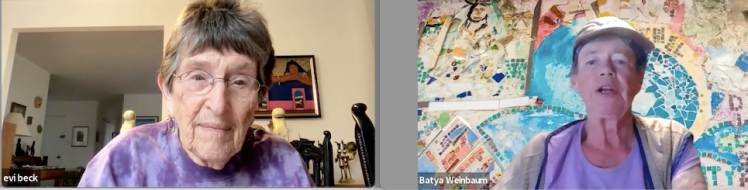
Interviewee: Evelyn Beck
Interviewer: Batya Weinbaum
Date: 01/25/2023
Evelyn Beck was born in Vienna, Austria, in 1933, the same year that Hitler came to power. At the age of five her family home was invaded by Nazis and her father was arrested and sent to concentration camps. Evelyn and the rest of her family were forcibly moved to a Jewish ghetto, and, later, when her father was released, the family fled to Italy. These experiences laid the groundwork for Evi’s future feminist activism in the U.S.: as one of the founding members of the National Women’s Studies Association, the Jewish Caucus and the Lesbian Caucus at NWSA, and her work on the anthology Nice Jewish Girls brought anti-semitism to the movement towards intersectional lesbianism in the early eighties. Evi founded Lesbian Studies at the University of Wisconsin, and Women’s Studies at the University of Maryland–where she also met Lee, her partner of 35 years. Evi believes strongly in the power of community and has been teaching sacred circle dance for the last twenty years. Evi visited the Archives in its founding era in the seventies, and found that “It was just a wonderful, empowering moment, an exciting and thrilling moment that this existed, even though it looked very far from what you would imagine an official archive might be.”
Transcript
Interviewer: Becca DiBennardo
Date: 01/23/2023
Growing up in a working-class family outside of Phoenix, Arizona, Jamie Anderson first found community by joining the Girl Scouts, and later at through lesbian bars (The Habit in particular) and women’s bookstores. In the seventies, Jamie’s activism was channeled through her music and involvement with the Women’s Center and Take Back the Night marches. Jamie’s experiences as a musician on the road led to writing of her memoir, Drive All Night; fueled by dissatisfaction with the treatment of women in music, Jamie’s second book, An Army of Lovers, addresses the music industry during the seventies and eighties. Jamie met her current partner, Pat, at the Michigan Womyn’s Music Festival in the early 2000s, marrying in Canada before it was legal in the United States. Jamie has donated her CDs and press materials to LHA over the course of her long career. Still teaching music and playing shows today, Jamie closes out this interview with the reflection, “it’s really important to honor our elders and older performers. You know, just because you get older doesn’t mean you stop making art.”
Transcript
Interviewer: Elise Tosatti
Date: 12/03/2021
Jane Kennedy, in this interview, centers her journey as a lesbian mother across the last three decades– harnessing the past as an offering for the future. Raised in an Irish Catholic family in the Lower East Side of New York City in the 1950’s, in 1977 Jane eventually moves to Asheville, North Carolina where she makes a home within a lively lesbian community. Along with her participation in local chapter of Women Against Violence Against Women and starting the first Women Take Back the Night March in 1979, “living in a woman’s nation was really kind of [her] ideal and… goal” of this period of life. Jane discusses an internal shift that took place around age 33, when her intention to be a mother clarified. Jane reflects on her path to motherhood during a time where using a known sperm donor was still “sort of off the grid.” Jane discusses the insemination process, her approach to motherhood, and negotiating custody both interpersonally with her ex-partner and legally with the sperm donor. She reflects on the effects these experiences as a lesbian mother had on her daughter and how she has navigated society’s growth towards affirming gay and lesbian family building. She concludes the interview stating, “my hope is that lesbian women know that having a child and family is absolutely possible.”
Transcript
Interviewee: Jill Guttman
Interviewer: Julia Rosenzweig
Date: 12/21/2022
Born in New Jersey in 1961 and raised in Plantation, Florida, Jill Guttman begins the narrative of her life story describing her first encounter with anti-semitism as a child. Aware of her attraction to girls at a young age she was able to give voice to that when she attended Florida State University and soon became involved in a long-term abusive relationship. Nevertheless, she earned an associate’s degree in fine art photography, and established a career as a photographer. At 23, Jill joined the Army, training as a medic and navigating military life in the pre-Don’t Ask, Don’t Tell era. Jill returned to Florida for photojournalism school and began attending the Michigan Womyn’s Music Festival, her festival photos later published in Lesbian Connections and Sinister Wisdom. Jill pivoted to nursing school, met a partner on AOL, and moved to Ohio to work in a pediatric ICU. She rejoined the Army to attend nurse anesthesia school, and was deployed in 2006 as part of Operation Iraqi Freedom, an experience that left her with PTSD. Ironically, after a bad experience with anesthesia led to a mental health crisis, Jill found her way to Buddhism, leading to a sense of peace that had previously been elusive. As a contributor to Archives, Jill shares, “the Lesbian Herstory Archives has always called to me since I started photographing lesbians.”
Transcript
Interviewer: Ivy Olesen
Date: 09/09/22
Jinny Heneberg was born in 1948 in the Bronx, New York, and is the younger of two siblings. A lifelong learner who attended both night school and graduate school to work on Wall Street and climb the all-male corporate ladder in the ‘60s, Jinny spent much of the beginning of her career in the closet. After reaching a management position and economic stability by the early eighties, Jinny realized that she had to come out because she didn’t want to teach people to be in the closet. Since coming out, Jinny has served on the board of the Gay and Lesbian Center, on the women’s committee at SAGE, (Advocacy & Services for LGBTQ+ Elders), has been active in NOW and as a member of Congregation Beit Simchat Torah (CBST). She has enjoyed a series of long-term relationships, the death of a beloved partner, and, as of this writing, is newly and happily involved. Jinny eventually pivoted from a high-profile career in finance to being a real estate broker in the Hamptons, where she now makes her home.
Transcript
Interviewee: Joanne Gold
Interviewer: Lauren Rollit
Date: 01/13/2022
Joanne Gold discusses her experience growing up in a suburban Jewish family and attending college in Buffalo, NY. At college, she developed an artistic practice as a ceramicist, was exposed to feminism, and met her lifelong parter Jodie. Disillusioned with the expectations of her art major, Joanne dropped out of school and moved with Jodie to Santa Fe, NM, where they built community with other lesbians and artists. They also were involved with the ARF Women’s Land Collective. Eventually, they moved near Northampton and Joanne studied dental hygiene. Guided by the support of other lesbians building families, Joanne and Jodie decided to have a child. Joanne talks about the painful legal process that they went through for them both to be recognized as Ozzy’s parents. She wraps up the interview reflecting on transness, parenting, and disability. In describing her relationship to Ozzy, Joanne invites the listener to consider the metaphor of “standing on [one’s] shoulders” in the context of queer kinship.
Transcript
Interviewer: Hannah Sullivan
Date: 08/08/2022
In this interview, Dr. Juanita Kirton talks about her childhood in the neighborhood of Bedford Stuyvesant in Brooklyn, New York, and with her West Indian Barbadian family and community. Childhood trauma leads Juanita to career paths of psychology and writing, both to deal with her own past and to help others navigate their experiences of trauma. After attending the HBCU Wilberforce University in the 1980s, Juanita became involved with the Gap Tooth Girlfriends writing group, to which she credits helping to find her voice as an emerging writer. She also starts a career in the Army, becoming a Sergeant in charge of a male platoon while staying closeted and raising a son. Writing as a source of healing and the importance of community is a thread that Juanita has woven throughout her personal, academic, and professional lives, including her work with Warrior Writers and Crossing Point Arts. Later in life Juanita found a new passion and community as a motorcycle rider, and as a member of the New York City Sirens Motorcycle Club which leads the NYC Pride parade each year.
Transcript
Interviewee: Kate Walter
Interviewer: Moss Berke
Date: 12/16/2022
Kate Walter is a high school teacher, professor, and author who came out in 1975. An active member in the Gay Teachers Association and the National Writers Gay Caucus, Kate speaks about the process of learning to balance being out in her personal life and being out over the course of thirty years as an educator. Kate’s writing career began in college with music reviews and later included publishing in the New York Times and The Advocate. Following the dissolution of her 26-year partnership during pre-marriage equality years, Kate found herself with no legal protection, a shift in her attitude towards gay civil rights, and the impetus to write her first novel, Looking for a Kiss: A Chronicle of Downtown Heartbreak and Healing (2015). Kate sent her first book to the Archives because “it’s so important to preserve our history and to tell other people about it…a lot of people don’t know what it was like to live without a gay rights bill or without gay marriage and what that was like, and plus, who knows what’s going on today, maybe some of these rights will be taken away. And it’s so important to continue to fight for them.” Her second book, Behind The Mask, is a memoir in essays about living alone in NYC during the pandemic.
Transcript
Interviewer: Emerald Rutledge
Date: 12/02/2021
In this interview, Kathy Wakeham reflects on coming of age in New York,, the meaning of lesbian social spaces, and weaving through various partnerships and travels. Kathy Wakeham describes growing up in a working class family in Yonkers. She discusses getting tracked into secretarial classes in high school and reckons with the racism and classism in her neighborhood, and the idea that “zip code is destiny.” After leaving Yonkers and eventually moving to the East Village—where she has lived for the past 48 years— she gets a job in the Columbia Libraries and is able to attend the University, tuition free. At Columbia, she comes out and becomes politicized. She gets involved with gay life through lovers, political groups, and the lesbian bar scene. She joins the Student Homophile League as one of the few female members, as well as the Gay Liberation Front. She takes part in the historic Lavender Menace demonstration advocating for the placement of lesbian liberation in the women’s movement. Kathy highlights travels, both alone and with partners, to various parts of Europe and Asia. Journeying through her life across place and partnership, Kathy shares passions like becoming a Buddhist, developing a creative practice, and snorkeling for the first time. She reflects on LHA, another important site of lesbian life and activism and describes it as “a bridge [between] the so called bar dykes and the political lesbians… a space where you could be yourself.”
Transcript
Interviewer: Allee Manning
Date: 04/07/2022
Growing up in Detroit, Michigan, Kay Turner forged space for performance and expression through her church choir and all girls summer camp. At the women’s college, Douglass College of Rutgers University, Kay’s lesbian idealism formalized connecting with other gay women, serving as the editor of the literary magazine, and helping to bring feminist figures to campus. In the 1970s after college, her career in performance and cultural production took off, first with the group “The Oral Tradition”, later founding “Girls in The Nose;” a rock punk band, and starting the journal “Lady Unique Inclination of the Night.” Kay researched for her book of lesbian love letters Between Us, among other projects, at LHA and “brought forward marginalized communities that have art forms that are very significant aesthetically” through her work at the Brooklyn Arts Council. Across this interview Kay reflects on the ways “politics was being done through making things” and the power in capturing “moments in the cycle, in which lesbian culture has been more or less important in terms of our understanding of culture, politics, and ways of being.”
Transcript
Interviewer: Soula Harisiadis
Date: 09/27/2021
In this interview, Linda Quinlan talks about growing up in a small working class town just north of Boston, Massachusetts. She shares her experience of dropping out of high school and creating a life influenced by the Beatnik generation. She discusses getting into college through a program for disadvantaged youth, as well as her experience navigating: dyslexia, classism, and single motherhood. Alongside the experience of building relationships with classmates in her program and nourishing her love for writing poetry, Linda participated in organizing efforts which culminated in the opening of the first Daycare Center at UMass Boston. She talks about moving to San Francisco after coming out and eventually moving back to Boston where she meets her long-term partner, Anne, through the feminist writing community. Together, Linda and Anne move to Madison, a place where Linda dives deeper into her work and is named Wisconsin Poet of the Year. As she chronicles her organizing and creative projects across place and time, she describes her relationship with creative discipline and how it conflicts with her urge to be interpersonal. Through her current news and interview show, “All Things LGBT,” she has created a space where her desires to both create and be with people can coexist.
Transcript
Interviewer: Cait McKinney
Date: 07/25/2021
In this interview, Sharon Deevey outlines themes of activism and connecting across differences throughout her career, interpersonal relationships, and her connection to her own body. She recounts growing up in a conservative family and meeting people from various backgrounds in boarding school and at Swarthmore College. She describes her shifting relationships and thoughts about various relationships structures. After coming out, she talks about getting involved in a historic Lesbian Separatist group called The Furies and reckoning with her own privilege; a lens through which she discusses some class struggles within the Women’s Movement in 1960’s America. In this discussion Sharon talks about her work as both a nurse and a librarian, and her dedication to the jobs delegated to women in that era, despite her sense that they weren’t always celebrated. She shares her journey around a pursuit for a health diagnosis and discusses various forms of agency that she leveraged within that process. The conversation concludes with a reflection on the need for archiving and the choice to archive her writing both at LHA and at an archive in Ohio (the state in which she has lived for much of her life.)
Transcript
Interviewer: Gail Robson
Date: 01/16/2022
Mary Kelly begins this interview reflecting on her childhood growing up on a farm in rural Wisconsin. Mary meets her long-term partner Pam at the beginning of college and recalls various visceral experiences in the face of homophobia. Mary and Pam move to California where Mary forges a career within the est community. As a result of this career, they move around the country quite a bit. Back in California, they adopt a child in the nineties as “parent and parent.” Mary touches on parenthood as someone whose presentation strays from the gender binary. After separating from Pam after 40 years, Mary lives in Minneapolis where she’s found community in writing and poetry and spends time with her grandchild, the joy of her life. Mary shares her poetry throughout the interview to expand on her-story.
Transcript
Interviewer: Brianna Suslovic
Date: 05/25/2022
In this interview, Moni Usasz talks about growing up on a farm and in college discovering the power of lesbian sisterhood. She outlines her involvement in National Organization of Women (NOW), the Nebraska Coalition for Women, and the formation of the Lincoln Legion of Lesbians (LLL). With LLL, Moni describes bringing feminist and lesbian education to the public, “sort of like being a professional lesbian.” Moni connected with LHA to donate LLL originals and shared that “when I asked if they had an archivist on staff, she— the woman I talked to on the phone— said, “We’re all archivists” and that was so totally a feminist perspective.” Moni reflects on the shifting experiences of sexuality, gender, and coming out across generations. Of her own experience she states, “it (coming out) was a really big deal back then. I mean, the only out of body experience I had was telling my mother I was a lesbian.” Across these reflections, Moni expresses a desire to continue centering and organizing around feminist values.
Transcript
Interviewer: Caro Carty
Date: 01/19/2023
In this life herstory, Naomi Littlebear Morena guides us through her life from her birth in LA and her childhood in the barrio in San Fernando Valley. Naomi felt the impact of racism and prejudice against her for speaking Spanish. A large part of her identity and source of healing was music and Naomi was appreciative of female cultural figures that provided reflection of her experiences. Her performances took her across parts of the US performing at festivals and she had her first relationship with a woman after a painful coming out experience. After her band broke up and she was working as a dishwasher, she found out that her song “You Can’t Kill The Spirit” was being sung by protesters at Greenham Common Women’s Peace Camp in England. “And I heard that…30,000 women surrounded the missile base, and they were singing my song.” Naomi went on to become a counselor and parole office and a later in life parent and continues to engage with music as a means for representation and political activism.
Transcript
Interviewer: Morgan Grey
Date: 12/29/202
Pat Cohen was born in Brooklyn, NY to a working-class Jewish family and was raised in a Long Island suburb. She shares her coming out story which included her mother attempting to endanger custody of her son as well as her partner’s job by outing them. Pat was involved with the founding of a lesbian committee in a women’s liberation group in Nassau, LI, and The Long Island Lesbian Thespians (LILT) within the context of creating a larger community. In the mid-70s she attended Long Island BOCES for auto repair, where she was the only woman in the class, starting a long career in the male-dominated automotive field earning an MBA and rising through the ranks at LILCO . Through BOCES Pat also was a volunteer Naturalist for many years. The Michigan Womyn’s Festival held a large place in her life- including working it, starting a business selling womyn-made products on the land, and first meeting Liz, her current partner of 35 years there. Pat has marched with LHA numerous times at Pride, sharing, “the Lesbian Herstory Archives…definitely influenced who I am.”
Transcript
Interviewer: Sam Zaccack
Date: 06/13/2022
In the beginning of this interview, Pearl Van Zandt talks about moving around a lot as a child until her family settled in Lincoln, Nebraska. After college, while working with Americorps VISTA in rural southern Oregon, Pearl helped start a women’s health center and met many lesbian feminists through that project. Pearl returned to Nebraska to pursue a Masters and PhD and she continued building lesbian community at the Women’s Center at the University. Pearl also discusses her involvement in the production of the Women’s Journal Advocate, a Lincoln periodical. Through a connection at a Women’s Studies Conference, Pearl met her wife Deb, and they have been partnered for 36 years. Pearl worked as the Executive Director of the State Agency for the Blind and currently, she is working on a project to produce an accessible measuring tool for blind woodworkers. While Pearl and her wife have stayed connected to a robust lesbian community in Lincoln, she talks about missing feminist-oriented spaces of her youth.
Transcript
Interviewer: Julia Lau
Date: 05/25/2022
In this interview, Robin Rosenbluth describes her impactful experience coming of age in the foster care system in New York. She reflects on college as an pivotal opportunity to expand her sensibility living abroad in Europe, Kenya, and Central America. After college, she moved to Washington, DC and states, “working for Quest, a radical feminist journal in DC, I was meeting all of these really extraordinary women who identified as lesbian.” Her connection to LHA began and deeply impacted her life when, in the early eighties, she learned that Joan Nestle was “inviting women to her apartment on the Upper West Side to talk about lesbians who wanted to have babies. And I was like, “oh, my God, that’s me! I’m going, I’m going!” And I was pumped, I was so pumped.” Through this group she learned about a sperm bank in New York and had two children with her partner of forty years. As a parent she has nurtured a deep sense of belonging and desire to give back and look out for others including her involvement with Astraea.
Transcipt
Interviewer: Baylee Woodley
Date: 06/10/2022
In this interview, J. Robin Whitley discusses her process of self-actualization as a religious lesbian living in rural North Carolina. While Robin knew she was a lesbian from an early age, pursuing a career in religion and because becoming a pastor was her calling, she lived half of her life in the closet. Robin discusses the conflict with her identity and vocation. She talks about building queer community through bars and bookstores and going out dancing. She explores her own gender and presentation. While her love for nature kept her in the rural South, she identifies that this environment shaped ways she needed to pass to survive at different points in her life. Robin’s wish to find a safe place for her writing, poetry, and pieces of her heart led her to discovering LHA. She also states one of the “other reasons I wanted to be a part of this project is because I’m like God love you, we just got to encourage young people to come out earlier and earlier.”
Transcript
Interviewer: Rebecca Heywood
Date: 07/26/2022
Born in Omaha, Nebraska, Ruth Kupfer describes coming into her identity as a lesbian after not having the language to name it. Ruth talks about navigating her role as a teacher and how open to be about her lesbian identity to her high school students. An experience with a student who sexually harassed her, which she wrote about in the book One Teacher in 10, solidified her desire to be an out role model for her students. In furtherance of this, at Lincoln High School, Ruth designed a Women’s Literature class that included lesbian characters and authors, organized a protest in Washington DC, and helped start the Gay Straight Alliance which is still active today. Ruth concludes the interview stressing the importance of preserving and accessing queer history.
Transcript
Interviewer: Kelly Roberts
Date: 01/06/2022
Across this interview Shatzi Weisberger explores themes of intergenerational friendship, organizing, and queerness. Shatzi first discusses her childhood in New York City. After her mother comes out, Shatzi is faced with questions of identity. Discovering language for her own sexuality, Shatzi attuned to the ways that language shifts across time. Shatzi highlights a commitment to organizing and social change. From her involvement with DONT (Dykes Opposed to Nuclear Technology), to teaching courses at Brooklyn Center for Ethical Culture, to her current participation in Jewish Voice for Peace— where she is commonly known as “the People’s Bubbie—” Shatzi demonstrates ongoing involvement with community activism. She wraps up the interview reflecting on death and the agency she desires within that process. As she reflects, she offers listeners the question, “what does managing pain and suffering look like?” and reminds us of the transformative power of gratitude.
Transcript
Interviewer: Alicia Mountain
Date: 08/25/2021
In this exchange, Zelda aka Judith Miller chronicles her life through a conversation guided by her performance piece “Que Será, Será: a Life’s Journey of Sexual Orientation and Gender Expression.” She unpacks the inspiration to create; tracing their personal journey as an artist by examining her experience in theater, creating a theatre company, living in an artist community, and working within movement spaces. She also explores what art is capable of unlocking for audiences. Zelda bravely makes the case that art unleashes authenticity for both artist and audience. Her performance and visual art explore themes around: gender, sexuality, spirituality, and freedom.
Transcript
Interviewer: Nayiree Roubinian
Date: 08/01/2021
In this interview, Susa Silvermarie discusses growing up in a large Catholic family in the 1950’s midwest United States. She talks about her role as a single lesbian mother and traces her varied career trajectory, including being the first female letter carrier in Wisconsin. Alongside her paid work, she lives a life dedicated to her writing. At times, Susa uses her poetry as answers, illustrating her practice of channeling writing as a tool for: constructing her own identity, building intentional community, and placing herself within a herstory of activism and change. Susa maintains a connection to LHA—where she set up her own collection 15 year ago. She states that “a couple times a year I make up a package [for LHA]. I send a personal journal, or news clippings, whatever I got to the Archives. And every time that I prepare that package, I just once again feel immensely grateful that LHA is there to receive it, to receive me, to gather me up, you know, like a mother.”
Transcript
Interviews without published transcripts have not completed the participatory review process.
 The Lesbian Elders Oral Herstory Project